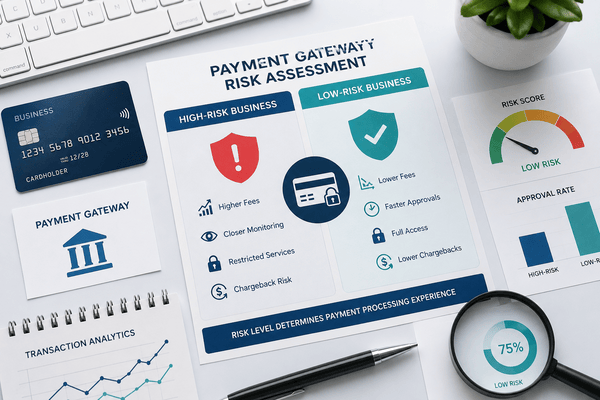
Picture two business owners. The first runs a small online bookstore. Payments clear smoothly, customers rarely dispute a charge, and the payment processor barely thinks twice about the account. The second runs a fast-growing CBD company. Orders are pouring in, revenue is climbing — but the payment processor treats the account very differently, adding extra fees, tighter terms, and closer monitoring. Both are legitimate businesses. The difference is how payment gateways classify risk. Low-risk businesses get predictable, low-cost processing. High-risk businesses face more scrutiny, more paperwork, and higher costs — not because they've done anything wrong, but because their industry, transaction patterns, or history carry more exposure for chargebacks, fraud, or regulatory trouble. This guide breaks down exactly how that classification works, what separates a low-risk business from a high-risk one, and how to choose a payment gateway that fits your situation.
What a Payment Gateway Actually Does
A payment gateway is the secure bridge between your customer, your business, and your bank. It encrypts sensitive data — like credit card numbers — and processes electronic payments safely and efficiently. Behind the scenes, it approves card payments, moves funds from the customer's bank into your account, and supports multiple payment methods, from credit and debit cards to digital wallets. None of this is free. Most gateways charge a per-transaction fee, and many also charge a monthly fee. That's exactly why choosing the right one matters — it directly affects how smoothly your payments flow and how much you pay to process them, whether your business is low-risk or high-risk. Some of the most widely used payment gateways include:
- PayPal
- Stripe
- Authorize.Net
- NMI
The Three Risk Tiers Payment Processors Use
Payment gateways don't just approve or reject businesses — they sort them into risk categories that determine how they're treated:
- Low-Risk: Businesses with stable revenue, low chargeback rates, and minimal regulatory concerns, typically operating in predictable industries.
- Gray or Middle-Risk: Businesses in legally uncertain or ethically gray areas that face moderate scrutiny and occasional payment challenges.
- High-Risk: Businesses prone to higher chargeback rates, fraud, and regulatory oversight, often operating in volatile or heavily regulated industries.
Each tier comes with its own rules for how payments and financial relationships are managed. Let's look at the two ends of that spectrum in detail.
Low-Risk Businesses: Why Processors Consider Them Safe Bets
A low-risk business is one that payment processors and banks view as safe and reliable. These businesses typically operate in stable industries, generate steady revenue, and rarely trigger customer disputes or chargebacks. Sales are predictable, customer loyalty is high, and financial trouble is uncommon — which makes it easier and faster for them to secure merchant accounts at lower cost. Common examples include retail stores selling non-perishable goods, professional services like accounting, and educational institutions.
Low-Risk Characteristics at a Glance
- Operates in industries labeled low-risk
- Single-currency operations
- Operations based in low-risk countries
- Monthly transactions under $20,000
- Ticket sizes below $500
- Low dispute rates (below 0.5%)
- Very low or zero chargebacks
- Around 100 transactions daily
- Minimal regulatory scrutiny
- Low initial investment
- Commonly approved by mainstream gateways like PayPal and Stripe
High-Risk Businesses: Why the Label Isn't Necessarily a Red Flag
Some businesses earn the "high-risk" label simply because banks and payment processors see them as more likely to generate chargebacks, fraud, or financial instability. Industries like gambling, CBD, and adult entertainment tend to face more disputes and tighter regulation. But industry isn't the only factor — your business history matters too. Poor credit, unpredictable sales, or a previously terminated merchant account can all push your risk rating higher. Being classified high-risk means tougher payment processing, higher fees, and stricter rules, which makes staying on track more difficult. Common examples include gambling platforms, SEO services, and subscription-based businesses.
High-Risk Characteristics at a Glance
- Monthly transactions over $20,000
- Over 100 transactions daily
- Higher overall transaction volume
- Ticket sizes above $500
- Multiple currencies
- High dispute rates (above 1%)
- Extended delivery timelines
- Frequent use of recurring billing
- Often requires specialized gateways like Authorize.Net
8 Signs Your Business Might Be Flagged High-Risk
Not sure where your business falls? These are the most common indicators payment processors look for:
- Industry Type: Operating in sectors like adult entertainment, tobacco, or firearms.
- Processing History: Frequent chargebacks or unusually large transaction volumes.
- Payment Methods: Heavy reliance on credit card transactions, especially international ones.
- Chargeback Ratio: High chargeback rates by transaction count or dollar value.
- Personal Credit: Low personal credit scores affecting reliability.
- Bank Statements: Irregular patterns that raise concerns.
- Sales Model: Business models like dropshipping, MLMs, or subscriptions naturally increase risk.
- International Sales: Transactions originating outside low-risk regions like the U.S. or Europe.
Low-Risk vs. High-Risk Business: The Big-Picture Comparison
Beyond payment processing, low-risk and high-risk businesses differ in how they operate and the challenges they face day to day. Low-risk businesses are predictable and stable. High-risk businesses deal with more uncertainty and greater scrutiny — but that doesn't mean they can't thrive with the right setup.
| Factor | Low-Risk Business | High-Risk Business |
|---|---|---|
| Risk Profile | Considered safe and reliable, with minimal disputes or fraud to worry about. | Faces more challenges, including higher chargeback rates and stricter regulations. |
| Types of Businesses | Retail stores and professional services such as accounting. | Gambling, CBD, or subscription-based services, where risks are naturally higher. |
| Industries Involved | Simple and steady industries that are easier to navigate. | More volatile or heavily regulated industries that are harder to manage. |
| Financing Options | Easier access to funding with lower fees. | Fewer financing options, often with higher interest rates. |
| Cost Implications | Lower transaction fees. | Higher transaction fees, reflecting the added risk. |
| Regulations | Easier fee structures and compliance processes. | Stricter regulations and tougher payment terms. |
| Revenue Stability | Steady, predictable income. | Unpredictable earnings and higher operational costs. |
| Examples | Retail stores, professional services, educational institutions. | Gambling, SEO services, subscription-based businesses. |
How Payment Gateways Treat Low-Risk vs. High-Risk Businesses
This is where the classification really shows up in day-to-day operations. Here's how payment gateways handle the two categories differently, feature by feature.
| Feature | Low-Risk Business | High-Risk Business |
|---|---|---|
| Payment Gateway Options | Access to mainstream gateways like PayPal or Stripe with simple setups and standard features. | Requires specialized gateways with advanced fraud detection and chargeback management, often at higher cost. |
| Requirements | Straightforward — proof of identity and business registration. | Stricter scrutiny, including financial history and compliance certificates. |
| Approval Process | Quicker, often completed within days. | Extensive checks, sometimes taking weeks, as processors assess risk. |
| Fees | Lower processing fees and minimal charges. | Significantly higher fees, reflecting the added risk assumed by the processor. |
| Chargeback Handling | Chargebacks are rare and easily managed. | Higher chargeback volumes requiring robust dispute-resolution tools. |
| Fraud Prevention | Basic fraud prevention features are sufficient. | Requires multi-layered authentication and real-time fraud monitoring. |
| Contract Terms | Flexible, short-term contracts. | Longer, more restrictive contracts due to elevated risk. |
| Industry Support | Gateways support a wide range of common industries. | Requires specialized gateways tailored to sectors like gaming, CBD, or adult content. |
| Payment Method Support | Standard methods like credit cards and digital wallets. | Additional support needed for international payments, crypto, or alternative methods. |
| Compliance Requirements | Simpler compliance with fewer regulatory hurdles. | Stricter requirements, often needing legal expertise and constant monitoring. |
| Customer Support | Standard customer support services. | Dedicated, round-the-clock support to manage complex issues. |
| Transaction Limits | Generally higher transaction limits. | May face limits on transaction amounts or daily processing caps. |
| Risk Management | Basic risk management practices. | Requires advanced tools and strategies to mitigate fraud and disputes. |
| Integration Flexibility | Seamless integration with standard platforms. | Often needs custom solutions to fit specialized gateway requirements. |
| Global Reach | Straightforward global payment options. | Restrictions on international transactions; only select processors qualify. |
| Rolling Reserves | Rarely required. | Often required as a safeguard against potential losses. |
| Data Security Standards | Meets basic security standards like PCI compliance. | Must exceed baseline standards with enhanced encryption and fraud protection. |
How to Choose the Right Payment Gateway for Your Business
Choosing a payment gateway isn't just about cost — it's about finding one that fits your industry's demands and protects your business from risk, especially if you're operating in a high-risk category. Not every gateway is built the same, and the right choice can make a real difference in how smoothly you handle your specific challenges. Here's what to evaluate:
- Industry Compatibility: Confirm the gateway specializes in your industry. High-risk businesses like gambling or adult entertainment need providers experienced with their specific regulations.
- Chargeback Management: Look for gateways with robust tools to monitor and reduce chargebacks — essential for high-risk businesses prone to disputes.
- Fraud Protection: Choose a gateway with advanced fraud detection to keep transactions secure, especially in higher-risk industries.
- Flexible Pricing: High-risk gateways tend to charge more. Compare pricing structures to find fair rates for your business size and volume.
- Global Payment Support: If you operate internationally, pick a gateway that supports multiple currencies and regions for seamless global operations.
- Customer Support: Opt for a gateway offering 24/7 support to resolve technical issues or disputes quickly.
Key Takeaways
- Payment processors see low-risk businesses as safe bets, offering quick approvals and lower fees.
- High-risk businesses face tougher rules, higher costs, and extra scrutiny due to chargebacks, fraud potential, or regulatory factors.
- Retail stores and professional services are classic low-risk examples, while industries like CBD, gambling, and adult content are typically labeled high-risk.
- Mainstream gateways like PayPal and Stripe work well for low-risk businesses, while high-risk ones need specialized options like Authorize.Net for stronger fraud protection.
- High-risk businesses often pay higher fees and deal with rolling reserves, adding to the cost of staying compliant.
- Regulatory hurdles are minimal for low-risk businesses, while high-risk ones must invest in strict compliance and advanced fraud prevention.
- Transaction limits and stricter terms are common for high-risk businesses, while low-risk ones enjoy more flexibility and smoother operations.
- Picking the right payment gateway isn't about cost alone — it's about finding one that matches your business's unique challenges and keeps everything running smoothly.
Frequently Asked Questions
What makes a business low-risk?
Low-risk businesses are steady and predictable, operating in industries with minimal disputes or regulatory challenges. They typically have low chargeback rates, stable income, and reliable customer bases.
What business has the lowest risk?
The lowest-risk businesses have consistent demand and fewer operational hurdles — think grocery stores, bookkeeping services, and educational institutions.
What businesses do banks consider low-risk?
Banks view businesses with predictable revenue, a clean financial history, and low chargeback rates as low-risk. Retail shops, professional services, and local businesses are typical examples.
What businesses do banks consider high-risk?
High-risk businesses usually operate in volatile industries like gambling, CBD, or adult entertainment. High chargeback rates or financial instability also contribute to this label.
What are the four major types of business risk?
- Operational Risk: internal disruptions like staff errors or technical issues.
- Financial Risk: challenges with cash flow, debt, or market changes.
- Compliance Risk: failing to meet legal or regulatory standards.
- Reputational Risk: negative public perception or bad reviews affecting trust.
Why would you choose a high-risk investment over a safer one?
High-risk investments often offer higher returns. Startups or volatile markets can yield bigger rewards compared to safer options like savings accounts or bonds.
Why are some businesses labeled high-risk by payment processors?
Payment processors classify businesses as high-risk if they face frequent chargebacks, operate in regulated industries, or have unpredictable income streams.
Can a high-risk business transition to low-risk status?
Yes. By improving financial stability, reducing chargebacks, maintaining compliance, and demonstrating a clean payment history, businesses can shift to a lower-risk status over time.
What payment gateway is best for high-risk businesses?
Gateways like Authorize.Net, Paykings, and First Data are trusted options. They cater specifically to high-risk businesses with fraud prevention and dispute management tools.
Are fees higher for high-risk businesses? Why?
Yes — because payment processors take on more risk. High chargeback rates, fraud exposure, and regulatory scrutiny all drive up costs for high-risk businesses.
How do payment gateways manage fraud for high-risk businesses?
High-risk gateways rely on tools like fraud detection software, transaction monitoring, and data encryption to prevent fraudulent activity. Is it harder for high-risk businesses to get approved for a merchant account? Definitely. Payment processors review high-risk businesses more carefully, and approval often takes longer due to concerns about disputes and financial stability. What factors influence the cost of payment gateways for high-risk businesses? Costs depend on the industry, chargeback rates, transaction volumes, and international sales. Higher risk generally means higher fees and stricter contracts.
How can high-risk businesses reduce chargeback rates?
- Use clear product descriptions and billing information.
- Prioritize customer support and satisfaction.
- Use fraud detection tools and verify customer identities.
- Use a chargeback management service.
- Strengthen payment authorization procedures.
- Monitor and analyze chargeback data.