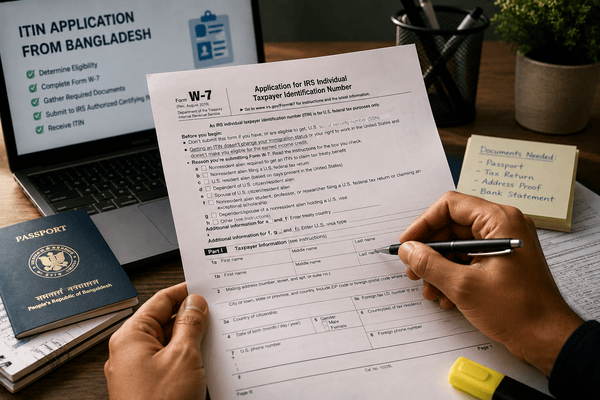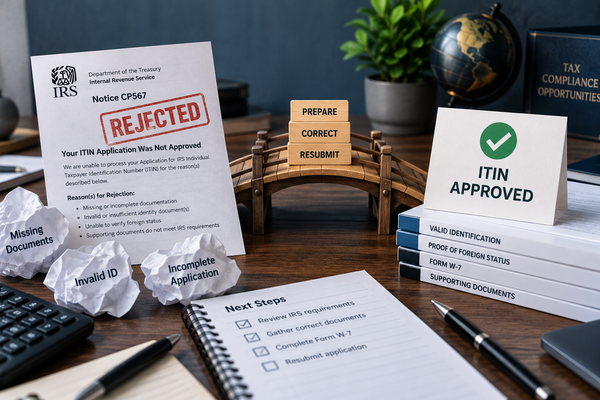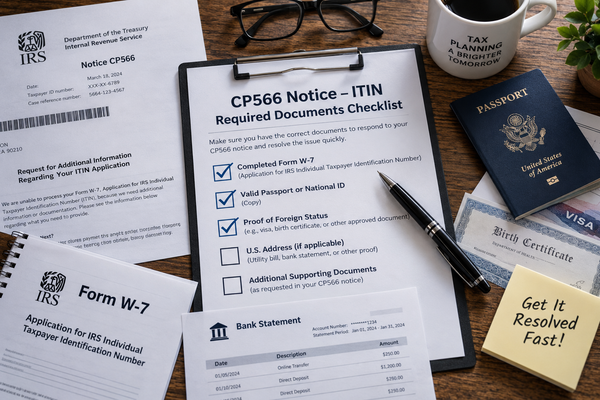
You've waited weeks for your ITIN approval, and instead an IRS letter shows up stamped "CP566 Notice." Take a breath — it's not a rejection. It's the IRS essentially saying, "We need a bit more from you." A CP566 Notice means the IRS couldn't finish processing your Form W-7 because something's missing or doesn't match — maybe an ID document, a passport copy, or the reason code on your form. The good news: it's completely fixable. Once you understand what the notice means and respond quickly with the right paperwork, you're in good shape to avoid extra weeks of waiting and keep your ITIN application from stalling out. Here's what CP566 actually means, what documents the IRS might be asking for, and exactly how to handle it.
What Is a CP566 Notice?
A CP566 Notice is an official IRS letter telling you your ITIN application is incomplete or missing key documentation. It doesn't mean you were denied — it means the IRS has paused your application until you fix what's missing. Common reasons you might receive a CP566 Notice include:
- A missing or invalid passport copy or identification document.
- No federal tax return attached, when one is required for your application.
- An incorrect or unclear reason code on Form W-7.
- Mismatched information — your name, birth date, or address doesn't line up across documents.
- Documents that weren't certified or verified properly by a recognized authority.
Once you correct and return the requested details, your case continues from where it left off.
Why the IRS Paused Your Application
The CP566 Notice shows up when the IRS hits pause on your ITIN application, usually because something in your paperwork didn't fully check out. It's not that you messed up — it's just that the IRS needs a bit more proof to confirm you actually qualify. Here's what it usually means in practice:
- The IRS couldn't clearly confirm your identity or foreign status, often due to missing verification or unclear documentation.
- The purpose behind your ITIN request wasn't fully supported — for instance, you claimed a tax treaty benefit or dependent status but didn't include the matching evidence.
- Your application package (Form W-7 and attachments) didn't meet all the filing requirements, such as proper certification or document format.
In short, the CP566 Notice is the IRS pausing the process to ask for confirmation — not rejecting your application. Once you respond with the requested proof, your ITIN application continues through normal review.
Six Steps to Resolve a CP566 Notice
Getting a CP566 Notice can feel nerve-racking, but it's really your shot to fix the paperwork and move your ITIN application forward. Here's how to work through it, step by step.
- Read the letter closely. The IRS clearly explains what's missing or unclear — whether it's your passport copy, proof of foreign status, or your federal tax return.
- Gather the required documents. Make sure every page is valid, clear, and officially certified. If you're outside the US, skip mailing your originals — instead get them verified through an IRS CAA (Certified Acceptance Agent) or your nearest US Embassy or Consulate.
- Include a short explanatory note (optional but smart). A one-line note like "I've attached my certified passport copy as requested in Notice CP566" helps the IRS match your response quickly.
- Send it to the correct address. Always mail your documents to the address listed on your IRS letter — not the standard Form W-7 address.
- Wait for your confirmation. Once everything's verified, the IRS will mail your CP565 Notice — your official ITIN approval letter. Depending on the time of year and where you filed from, this normally arrives between 7 and 11 weeks.
- Confirm resolution. Responding clearly and on time ensures your CP566 case gets resolved without unnecessary reapplications or delays.
How Long Do You Have to Respond?
You typically get 45 days from the date on the notice to reply. Miss that window, and your ITIN application goes cold — you'll have to start all over again. If your documents are still being certified overseas or you just need a bit more time, call the IRS and ask for an extension. They do allow it, as long as you reach out before the clock runs out.
Can You Get an Extension Past the 45-Day Deadline?
Good news: yes, in certain cases. Many applicants facing travel delays, document verification issues, or overseas mailing challenges have successfully received extensions by explaining their situation directly to the IRS ITIN unit. Here's how to make it happen:
- Call the ITIN unit early. Don't wait until the last day. Explain your situation clearly — travel, health, being abroad, or any other valid reason for delay.
- Ask politely for accommodation. Extensions aren't guaranteed, but the IRS often allows extra time when you reach out proactively.
- Send what you can, even if incomplete. Include a short note explaining why the remaining documents will follow soon.
- Never go silent. The 45-day window isn't always an absolute cutoff, but ignoring the notice entirely can lead to your application being closed.
Bottom line: the 45-day deadline on a CP566 is more of a guideline than a hard stop, but your safest move is still to respond as quickly as possible, or contact the IRS to get your situation noted before the deadline passes. The ultimate safety net is consulting with an IRS-verified CAA.
Four Ways to Avoid a CP566 Notice Entirely
Most CP566 Notices happen because of simple, avoidable mistakes — usually in the paperwork or certification process. A little care upfront can save you months of waiting later.
- Use certified copies or CAA-verified passports. The IRS rejects scanned or notarized copies that don't meet their standards. A Certified Acceptance Agent (CAA) can verify your passport locally so you never risk mailing the original.
- Match your reason code to your situation. Double-check that your Form W-7 reason — tax filing, dependent claim, or US property sale, for example — aligns perfectly with your supporting documents.
- Attach your tax return unless you qualify for an exemption. Many applications get flagged because applicants skip this part assuming it's optional — in most cases, it isn't.
- Keep copies of everything you send. If the IRS needs clarification later, you'll already have your records on hand.
Working with a Certified Acceptance Agent, like our CAA team at Cloudtech, makes all the difference. We review your application, certify your documents, and make sure your ITIN package meets every IRS requirement — so you never have to deal with a CP566 Notice in the first place.
What Happens If You Ignore It
If you ignore your CP566 letter, the IRS simply closes your case and treats your ITIN application as abandoned. No ITIN, no progress — you'll have to start over with fresh documents, a new form, and another long wait. Ignoring it also delays anything tied to your ITIN, like tax refunds, property sales, or dependent claims. Don't set it aside — treat it as a priority task.
Cloudtech: IRS-Certified Help for ITIN Applications
Dealing with a CP566 Notice from outside the US can feel frustrating, especially when documents need international certification or mailing. That's exactly where we help. At Cloudtech, we're an IRS-authorized Certified Acceptance Agent (CAA) — the first in Bangladesh — helping clients fix CP566 issues quickly and correctly. We verify your passport locally (no mailing originals required), identify what went wrong in your previous submission, and file your ITIN package directly with the IRS, so you don't risk rejection again.
Frequently Asked Questions
What is CP566?
It's an IRS letter letting you know your ITIN application isn't complete. Think of it as a polite nudge, not a rejection — the IRS just needs a few more documents before it can process your application.
How do I respond to a CP566 Notice?
Follow the instructions in the notice. Gather what's missing — your passport copy or tax return, for example — and mail everything to the address shown on the letter.
How long do I have to reply?
Normally 45 days from the notice date. Miss that window, and you'll have to start over with a new ITIN application.
Can I really get more than 45 days to respond?
Yes, if you have a valid reason, like waiting on certified documents or being outside the US. Call the IRS ITIN unit and request extra time. It's not automatic, but they often note your file and grant a reasonable extension if you reach out before the deadline passes.
What if I already missed the 45-day deadline?
Don't panic. Call the IRS as soon as possible to explain the situation. In many cases, if your documents are nearly ready, they'll advise whether you can still send them or need to reapply. Communication is key — ignoring the notice entirely is what truly ends your application.
What happens if I ignore the CP566 Notice?
Your ITIN request gets canceled, and you'll need to reapply from scratch — a delay you can easily avoid by responding on time.
What documents commonly trigger a CP566 Notice?
Most of the time, it's something simple: an unverified passport, a missing tax return, or an incorrect reason code on Form W-7. A quick check before mailing could save you weeks later.
What's the difference between CP566 and CP567?
CP566 is a "missing information" notice, while CP567 is an actual rejection after the IRS determines your ITIN can't be approved.
Can a Certified Acceptance Agent help with CP566 issues?
Yes. A CAA can verify your documents, identify what's missing, and submit a corrected application directly to the IRS.
Closing Thoughts
A CP566 Notice doesn't mean your ITIN application failed — it just means the IRS needs a bit more from you. Once you provide the missing documents or verification, your file moves forward normally. The key is responding correctly and quickly. And if you'd rather skip the confusion entirely, a trusted IRS Certified Acceptance Agent like Cloudtech can handle the process end-to-end, from reviewing your notice to getting your approval letter. Because when it comes to taxes and time, clarity always pays off.